Disc Golf Training Aids: Best Tools to Build Form at Home

Quick Comparison
| Product | Best For | Price |
|---|---|---|
Players who want to groove their pull-through and add arm speed for backhand and forehand | Check Price | |
Players who want a resistance trainer with a heavier top-end band at a low price | Check Price | |
Players who want a near-permanent practice basket that catches like a real course target | Check Price | |
Players who want one basket that handles backyard reps and travels easily to the field | Check Price | |
Players who want a sturdy 24-chain basket at the lowest reasonable price | Check Price | |
Warm-ups, shoulder prehab, and rotational strength drills before rounds and at home | Check Price | |
Players managing or preventing disc golfer's elbow while building forearm and grip strength | Check Price |


Players who want to groove their pull-through and add arm speed for backhand and forehand
Check Price on AmazonPlayers who want a resistance trainer with a heavier top-end band at a low price
Check Price on AmazonPlayers who want a near-permanent practice basket that catches like a real course target
Check Price on AmazonPlayers who want one basket that handles backyard reps and travels easily to the field
Check Price on AmazonPlayers who want a sturdy 24-chain basket at the lowest reasonable price
Check Price on AmazonWarm-ups, shoulder prehab, and rotational strength drills before rounds and at home
Check Price on AmazonPlayers managing or preventing disc golfer's elbow while building forearm and grip strength
Check Price on AmazonHere is the verdict up front: you do not need a closet full of gadgets to get better at disc golf. You need two or three disc golf training aids that match the part of your game you actually want to fix, and the discipline to use them three times a week. A resistance trainer for distance and form, a practice basket for putting reps, and a set of bands for warm-up and injury prevention will move your game more than any new driver.
The trap most players fall into is buying the disc instead of building the engine. A faster driver does not add distance if your form leaks power. Better chains do not sink putts if you have never grooved a repeatable stroke. The disc golf training aids in this guide work because they let you put in volume at home, in the yard, or in a garage during the off-season, when there is no course nearby and no excuse not to practice.
This guide breaks training tools into the three buckets that matter, recommends the best product in each, and finishes with a simple at-home routine that ties them together. Most of these are available on Amazon with a verified listing, and the disc-golf-specific picks are standouts worth the direct-from-brand purchase.
Quick Picks: Best Disc Golf Training Aids at a Glance
- Best for Distance and Form: ProPull Disc Golf Resistance Trainer - a disc-shaped resistance system that grooves your pull-through and arm speed for both backhand and forehand
- Best for Putting Practice: MVP Black Hole Pro HD - a 30-chain portable basket that catches and holds like a real course target so your reps actually count
- Best Budget Pick: Fit Simplify Resistance Loop Bands - a five-band set for warm-ups, shoulder prehab, and rotational drills for the price of two premium discs
- Best All-Around: DGA Mach Lite Portable Basket - a regulation-feel folding basket light enough to carry anywhere, the single most useful training aid for most players
What Disc Golf Training Actually Improves
Before you spend money, get clear on what training aids can and cannot do. They do not replace throwing real discs on a real course. What they do is let you train the underlying skills in isolation, with more reps, more often.
There are four things worth training, and different tools target each:
- Form and distance. Most distance comes from sequencing - hips, then chest, then arm, then a snappy release - not from muscling the disc. Resistance trainers let you rehearse that sequence under load so the correct motion becomes automatic. They also build the specific pulling strength your throw uses. If your form is the bottleneck, start with our complete guide to throwing disc golf and pair it with a resistance trainer.
- Putting consistency. Putting is the highest-leverage skill in disc golf and the easiest to practice at home. A practice basket lets you throw hundreds of putts a week from the same spots, which is the only way to build a stroke you trust. Volume is everything here, and our putting guide covers the mechanics to drill.
- Strength and arm speed. Disc golf rewards explosive rotational power and a strong, stable grip. Bands and resistance tools build that without a gym membership.
- Fitness and injury prevention. Disc golfer's elbow, shoulder strain, and wrist tendonitis are common and almost always come from skipping warm-ups or overthrowing cold. Mobility and prehab tools keep you on the course.
A good plan touches all four. You do not need a separate product for each, but you should know which bucket every purchase serves. Now to the tools.
The Best Disc Golf Training Aids Reviewed
ProPull Disc Golf Resistance Trainer
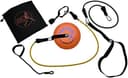
Pro Pull Resistance Trainer for Disc Golf
Players who want to groove their pull-through and add arm speed for backhand and forehand
Pros
- Disc-shaped grip mirrors your real throwing hand position
- Two resistance levels cover both technique work and strength work
- Tree strap and door anchor make it usable indoors or outdoors
- Trains forehand and backhand, unlike most generic trainers
Cons
- Reinforces whatever form you bring to it - good or bad
- Sold mostly direct and through disc golf retailers, so stock can vary
- No coaching content included, so you supply the technique knowledge
The ProPull is the closest thing to a purpose-built distance trainer in disc golf, and it is the one I recommend first to players chasing more power. Instead of a generic handle, you grip an actual disc-shaped molded piece, so the trainer rehearses the exact hand position and pull path you use on the course. You anchor the band to a tree outside or a door inside, set up in your throwing stance, and pull through your motion against resistance.
What this builds is the reach-back-to-release sequence under load. When you pull a band instead of a free disc, you immediately feel where your power leaks - usually rounding the disc out away from your chest, or firing the arm before the hips. Slow, deliberate reps against the 5 lb band fix sequencing. Faster reps against the 8 lb band build the specific pulling strength a hard throw demands. It works for forehand too, which most generic trainers handle poorly.
The trade-off is that resistance training rehearses the motion but cannot teach you what the correct motion is. Pair it with video of your throw or a coaching resource so you are grooving good form, not reinforcing a flaw. Used that way, 10 minutes a day genuinely transfers to the field. If you are working on shot shapes, this trainer also helps you build the controlled power a hyzer flip needs.
QOGIR Resistance Trainer for Disc Golf
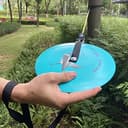
QOGIR Resistance Trainer for Disc Golf
Players who want a resistance trainer with a heavier top-end band at a low price
Pros
- Heavier 10 lb band gives stronger throwers a real strength stimulus
- Softer grip is comfortable for longer training sessions
- Consistently in stock on Amazon
- Lower price than comparable disc golf trainers
Cons
- Disc grip feels slightly less like a real disc edge
- Heavy band tempts beginners to overload before form is ready
- Like any trainer, it cannot correct form on its own
The QOGIR is the value alternative to the ProPull and a genuinely good trainer in its own right. The concept is identical: a disc-shaped grip on a resistance band you anchor to a tree or door, used to rehearse your pull and build arm speed. The differences are in the details. QOGIR uses a softer, grippier plastic for the disc piece, which some players prefer for comfort during long sessions, and it ships with a heavier 10 lb band versus the ProPull's 8 lb.
That heavier band matters if you are already a strong thrower and want a real strength stimulus rather than just a technique cue. Beginners should stick with the 5 lb band for weeks before touching the heavy one - the goal early on is clean, repeatable sequencing, and too much resistance wrecks form. The three difficulty configurations give you a sensible progression as you improve.
It is reliably stocked on Amazon, which makes it the easier buy of the two trainers. The honest knock is that the disc grip, while comfortable, feels a touch less like a real disc edge than the ProPull's molded piece, so the hand-position carryover is marginally weaker. For most players that difference is small and the price gap makes the QOGIR the smart pick.
MVP Black Hole Pro HD
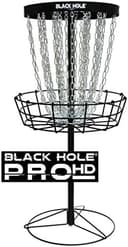
MVP Disc Sports Black Hole Pro HD 30-Chain Disc Golf Basket
Players who want a near-permanent practice basket that catches like a real course target
Pros
- 30 chains with inner tier catch and hold putts like a real course basket
- Heavy-gauge wire build holds up to weather and heavy use
- Disassembles in about a minute for transport
- Honest catching feedback makes every practice rep count
Cons
- Most expensive aid in this guide
- Heavier than ultralight portable baskets
- Overkill for casual or occasional putting
If putting is your weak spot - and for most players it is - a quality practice basket is the highest-return training aid you can own. The Black Hole Pro HD is the one to buy if you want a basket that will live in your yard for years and catch like the real thing. The 30-chain configuration, including an inner third tier, kills disc speed and holds putts that a thin-chained budget basket would spit out. That matters: practicing into a basket that rejects good putts teaches you nothing useful.
The HD designation means heavy-gauge wire and a tougher build than MVP's lighter baskets. It stands up to weather and constant use, and it still breaks down in about a minute for transport to a field or a friend's yard for a temporary course. The catching realism is the headline feature - putts that would hit chains and stay on a course basket will do the same here, so the feedback you get during practice is honest.
The cost is the obvious downside. At around $230 this is the priciest pick in the guide, and it is overkill if you only want to throw a few casual putts. But spread across years of daily putting reps, it is cheap per session. If you are serious about lowering your score, buy a basket before you buy another driver, and buy one that catches like this.
DGA Mach Lite Portable Basket
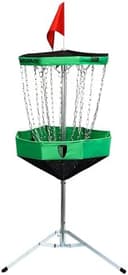
DGA Mach Lite Portable Disc Golf Basket
Players who want one basket that handles backyard reps and travels easily to the field
Pros
- Folds into an included carry bag for true portability
- Regulation size and height for direct transfer to course play
- Proven DGA Mach chain design catches well
- Reasonable price for a quality folding basket
Cons
- Folding mechanism adds a long-term wear point
- 16 chains catch slightly less than dense premium baskets
- Lighter base can shift on very fast putts in wind
The Mach Lite is the basket I recommend to most players, and the reason is simple: it folds. DGA is the company founded by the inventor of disc golf, and the Mach chain system has been the standard on real courses for decades. The Lite takes that proven catching design and makes it collapsible, so the whole thing folds down into an included carry bag and rides in a car trunk without trouble.
At about 25 lbs it is light enough to carry from the garage to the yard or out to an open field for distance and approach practice. The 16-chain setup catches well for a portable basket - not quite the chain density of the Black Hole Pro HD, but plenty honest for everyday putting reps and approach drills. Regulation size and height mean the muscle memory you build at home transfers directly to course baskets.
The trade-off versus a heavier fixed basket is durability and ultimate catching power. The folding mechanism is one more thing that can wear over years of hard use, and very fast putts can blow through occasionally where the denser Pro HD would hold. For the vast majority of players, the portability and the lower price win easily. This is the best all-around training aid in the guide for a reason.
MVP Black Hole Lite
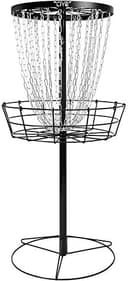
MVP Disc Sports Black Hole Lite 24-Chain Disc Golf Basket
Players who want a sturdy 24-chain basket at the lowest reasonable price
Pros
- 24-chain layout with no weak pockets catches consistently
- Pro-series threaded connector assembly is solid
- Powder-coated steel resists rust outdoors
- 2-year limited warranty backs the build
Cons
- Catches less aggressively than 30-chain premium baskets
- Disassembles rather than folds, so transport is fiddlier
- Not the cheapest option if budget is the only concern
The Black Hole Lite is the budget entry into MVP's well-regarded basket line. It uses the same threaded tension connector assembly as the Pro series, so it goes together solidly, but it trims weight and chain count to hit a lower price. You get 24 chains arranged 12 inner and 12 outer with no weak pockets, which is a real step up in catching consistency from the bargain-bin baskets that flood Amazon at half this price.
At about 26 lbs it is portable enough to move around the yard, though it does not fold like the Mach Lite - it disassembles into poles and the basket. The powder-coated steel resists rust through normal outdoor use, and the 2-year limited warranty signals MVP's confidence in the build. For a player who wants a dependable basket and does not need the maximum chain density of the Pro HD, the Lite is the sensible middle ground.
The honest limitation is that 24 chains catch less aggressively than the 30-chain Pro HD, so the hardest putts can occasionally cut through. And because it disassembles rather than folds, transport is slightly more fiddly than the Mach Lite. But as a stay-at-home practice basket that catches honestly and lasts, it is hard to beat at this price.
Fit Simplify Resistance Loop Bands
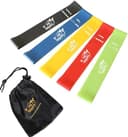
Fit Simplify Resistance Loop Exercise Bands, Set of 5
Warm-ups, shoulder prehab, and rotational strength drills before rounds and at home
Pros
- Five resistance levels cover warm-up through strength work
- Extremely cheap insurance against shoulder and elbow injury
- Packs flat into any disc golf bag for pre-round warm-ups
- Doubles as a rotational-sequence training tool
Cons
- Not a dedicated distance or form builder
- Looped bands can roll or pinch during some movements
- Lighter bands wear out faster with heavy daily use
Every disc golfer should own a set of resistance loop bands, and this Fit Simplify set is the easiest recommendation in the guide. At around $13 it costs less than two premium discs, and it covers a part of training the flashier aids do not: warming up properly and building the small stabilizing muscles that keep your shoulders and elbows healthy.
The five bands range from extra light to extra heavy, so you can dial the right resistance for any drill. For disc golf, the highest-value uses are pre-round warm-up - light band pull-aparts and shoulder external rotations get blood into the rotator cuff before you throw cold, which is the single best defense against shoulder and elbow strain. You can also loop a band around a post and rehearse slow, controlled rotational pulls to reinforce the hip-leads-the-arm sequence, much like a resistance trainer but without the disc-specific grip.
This is not a distance-building tool on its own, and that is the point - it is prehab and warm-up insurance. Disc golfer's elbow sidelines more players than any equipment failure, and almost all of it traces back to throwing hard without preparing the joint. For the price, a band set that lives in your bag is the cheapest injury prevention you can buy.
THERABAND FlexBar
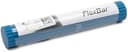
THERABAND FlexBar Resistance Bar, Blue, Heavy
Players managing or preventing disc golfer's elbow while building forearm and grip strength
Pros
- Clinically studied for reducing elbow tendonitis pain
- Builds forearm and wrist strength for a stronger grip
- Compact, durable, and needs no anchor or setup
- Works as both prehab and active rehab
Cons
- Blue Heavy is too stiff for players rehabbing an acute injury
- Not a distance or form trainer
- Requires consistent routine to see benefit
The FlexBar is the rehab and prehab tool that belongs in every serious player's kit. It is a flexible rubber bar you twist and bend, and it is best known for the Tyler Twist exercise, a movement clinically studied to reduce elbow tendonitis pain and rebuild tendon strength. Disc golfer's elbow - tendon pain on the inside or outside of the elbow from repetitive throwing - is one of the most common injuries in the sport, and the FlexBar is the standard tool for treating and preventing it.
Beyond rehab, the bar builds the eccentric forearm and wrist strength that a powerful, controlled release depends on. A strong, stable grip lets you hold the disc firmly through the hit and snap it cleanly, and the twisting resistance of the FlexBar trains exactly those muscles. Used for a few minutes a few times a week, it keeps the elbow resilient so you can throw hard without flaring up an injury.
The Blue Heavy version listed here needs about 25 lbs of force to bend, which suits most adult players already throwing with some power. Players coming back from an active elbow injury should start with a lighter bar - the Red Light or Green Medium - and progress up. The honest note: this is preventive and rehabilitative, not a distance gadget, but staying healthy is what keeps you playing, and that is worth $25.
How to Build a Simple At-Home Practice Routine
Owning training aids does nothing if they sit in the garage. Here is a realistic routine that uses the tools above without taking over your week. Aim for three or four short sessions, not one marathon.
Every session, start with the bands (5 minutes). Before you throw anything, do two sets of band pull-aparts and shoulder external rotations with a light Fit Simplify band. This warms the rotator cuff and is the difference between throwing for years and nursing a sore shoulder.
Putting days (15 to 20 minutes, 3x per week). Set your basket at a fixed distance and throw a stack of putts. Start at 15 feet, make 25 in a row, then step back to 20 and 25 feet. Track makes so you can see progress. Consistency comes from volume from the same spots, not from constantly changing distance. This is where a basket like the Mach Lite or Black Hole Lite earns its price.
Form and distance days (10 to 15 minutes, 2x per week). Anchor your resistance trainer and do slow, deliberate pull-through reps with the light band, focusing on letting the hips lead. Then a few faster reps with the heavier band for arm speed. Quality over quantity - 20 clean reps beats 60 sloppy ones.
Two or three times a week, end with the FlexBar. A couple of sets of the Tyler Twist keeps the elbow tendons strong and resilient. It takes two minutes.
That is it. Roughly 20 minutes a day, four days a week, and you will see it on the course within a couple of months. If you are still building your disc lineup alongside this, our guide to the best disc golf discs for beginners pairs well with a form-focused training plan.
Frequently Asked Questions
Do disc golf training aids actually work?
Yes, with one condition: they train skills in isolation but cannot teach you correct technique on their own. A resistance trainer grooves whatever pull you bring to it, so pair it with good form instruction. A practice basket works because it lets you log hundreds of honest putting reps you would never get on the course. Used consistently and correctly, training aids genuinely lower scores.
What is the single best training aid to start with?
A practice basket. Putting is the highest-leverage skill in disc golf and the easiest to drill at home. The DGA Mach Lite is the best starting point for most players because it catches like a real basket, folds for transport, and costs around $110. If budget is tight, a set of resistance bands at around $13 is the cheapest meaningful purchase.
Will a resistance trainer add distance to my throws?
It can, but indirectly. A resistance trainer builds pulling strength and lets you rehearse the throwing sequence under load, both of which support more distance. But distance comes mostly from technique - clean sequencing and timing. Use the trainer to reinforce good form, not to muscle the disc, and the distance follows.
How do I prevent disc golfer's elbow?
Three things. Warm up before every round with light band work for the shoulders and forearms. Do not overthrow when cold or fatigued. And build tendon resilience with a tool like the THERABAND FlexBar using the Tyler Twist exercise a few times a week. Most elbow pain comes from throwing hard without preparing the joint.
Can I practice disc golf indoors in winter?
Yes. A resistance trainer with a door anchor lets you rehearse your throwing motion indoors, and a FlexBar and resistance bands need no space at all. A folding practice basket can go in a garage or basement for putting reps. The off-season is when consistent home training pays off most, because everyone else stops.
How much should I spend on training aids?
You can build a complete kit for under $200: a resistance trainer (~$30 to $35), a band set (~$13), and a FlexBar (~$25), plus a portable basket (~$110). The basket is the biggest single cost and the best value over time. Start with what targets your weakest skill rather than buying everything at once.
Are cheap practice baskets on Amazon worth it?
Usually not. The very cheapest baskets use thin, sparse chains that spit out putts a real course basket would catch, which trains bad feedback into your stroke. Spend enough to get an honest catching basket - the MVP Black Hole Lite or DGA Mach Lite are the floor for quality. A basket that rejects good putts is worse than no basket.
How long until I see results from training at home?
With a consistent routine of three or four short sessions a week, most players notice improvement in putting confidence within four to six weeks and form changes within a couple of months. Training aids reward consistency far more than intensity. Twenty focused minutes most days beats one long weekend session.
Final Thoughts
The best disc golf training aids are the ones you will actually use, matched to the part of your game you most want to fix. For the biggest single improvement, buy a practice basket and putt every day - the DGA Mach Lite folds and travels, while the MVP Black Hole Pro HD is the catch-like-the-real-thing upgrade and the MVP Black Hole Lite splits the difference on price.
To build form and distance, a resistance trainer like the ProPull or the value-priced QOGIR Resistance Trainer grooves your pull-through under load. And do not skip the unglamorous tools - a Fit Simplify band set for warm-ups and a THERABAND FlexBar for elbow health are the cheap insurance that keeps you throwing for years.
Pick two or three, build the 20-minute routine above, and stay consistent. The players who improve fastest are not the ones with the newest discs - they are the ones who put in honest reps at home. For more on the technique to drill with these tools, see our guides on throwing disc golf, putting, and the hyzer flip.
Affiliate Disclosure
This post contains affiliate links. As an Amazon Associate, Pine Tree Disc earns from qualifying purchases at no additional cost to you. Learn more
Isaac "Steaks" Salisbury is the Maine native who founded Pine Tree Disc Golf. He's been throwing plastic through Maine's forests and fairways for years and started Pine Tree to build disc golf gear and content that players can wear and trust on and off the course.
Learn more about Pine Tree Disc →